

Most Colorado construction news comes from Denver and the Front Range, the urban corridor along the eastern edge of the Rockies. Much of the state’s public infrastructure work happens farther west and higher up. Below is a plain summary of recent announcements, with sources, followed by what they mean for the people who plan and pay for this work.
Grand Junction: A Steady Pipeline
The newest announcement is the Colorado Department of Transportation’s (CDOT) I-70B East of Third Street Improvements. It is a $13.8 million reconstruction of I-70B (Pitkin Avenue) and I-70Z (Ute Avenue) between Third and Sixth streets. Native Sun Construction Inc. is the prime contractor, meaning the firm that holds the contract with the owner and is responsible for delivering the work. Construction is scheduled from February 2026 to February 2027.
This is the seventh phase of improvements along I-70B. Phase 6, the I-70B South of Rood project, finished in October 2025.
Other work is already done. In 2025, crews completed I-70 Business Loop upgrades, U.S. 6 roundabouts and a new roundabout at Horizon Drive, 27½ Road and G Road. One segment ran long because crews hit unexpected subsurface conditions, meaning soil, rock, water or buried objects that differed from what the plans assumed.
Two more projects are in the pipeline:
- 29 Road. As of December 2025, the city was advancing design for a potential $80 million project, even though voters had rejected construction funding. The estimate splits into $68 million for an I-70 interchange (a junction where ramps connect roads without crossing traffic) and $12 million for 29 Road improvements.
- Four Canyons Parkway. The city plans a five-lane arterial from 24 Road to 25 Road and Patterson Road. An arterial is a main road built to carry traffic between districts. Phase 1 is complete and included a signalized intersection at 24 Road and a roundabout at 24 1/2 Road.
Durango: A Regional First
South of Durango, CDOT chose Lawrence Construction and RS&H, Inc. to design and build the $98.6 million US 550/160 Connection South project. This award dates to 2019. It is not a new announcement. The project realigns US 550 into the existing US 160 interchange near Grandview and replaces the steep, curved grade on Farmington Hill.
The Durango Herald reported it would create the first full highway interchange in Southwest Colorado and widen parts of Highway 550 to four lanes. It also involved massive excavation.
Gunnison and Delta Counties: Repair and Resurfacing
Not every project is new construction. During a Federal Highway Administration–required inspection of high-strength steel bridges, CDOT found a defect in the US 50 Blue Mesa bridges west of Gunnison. Emergency repairs followed, with completion scheduled for summer 2025. The source gives the schedule, not a confirmed finish date.
CDOT’s November 2025 report also highlights surface treatments, which are new top layers that extend a road’s life without full reconstruction. They include 12 miles of CO 317 east of Hamilton and CO 65 in Orchard City, Delta County, from the CO 92 intersection to mile post 6.5.
Southern Mountain Communities: Smaller Grants, Real Needs
Smaller towns depend on state and federal grants. The Department of Local Affairs awarded $780,000 to 13 projects through its 2025 Rural Economic Development Initiative, including $134,030 for Alamosa and $100,000 for Custer County.
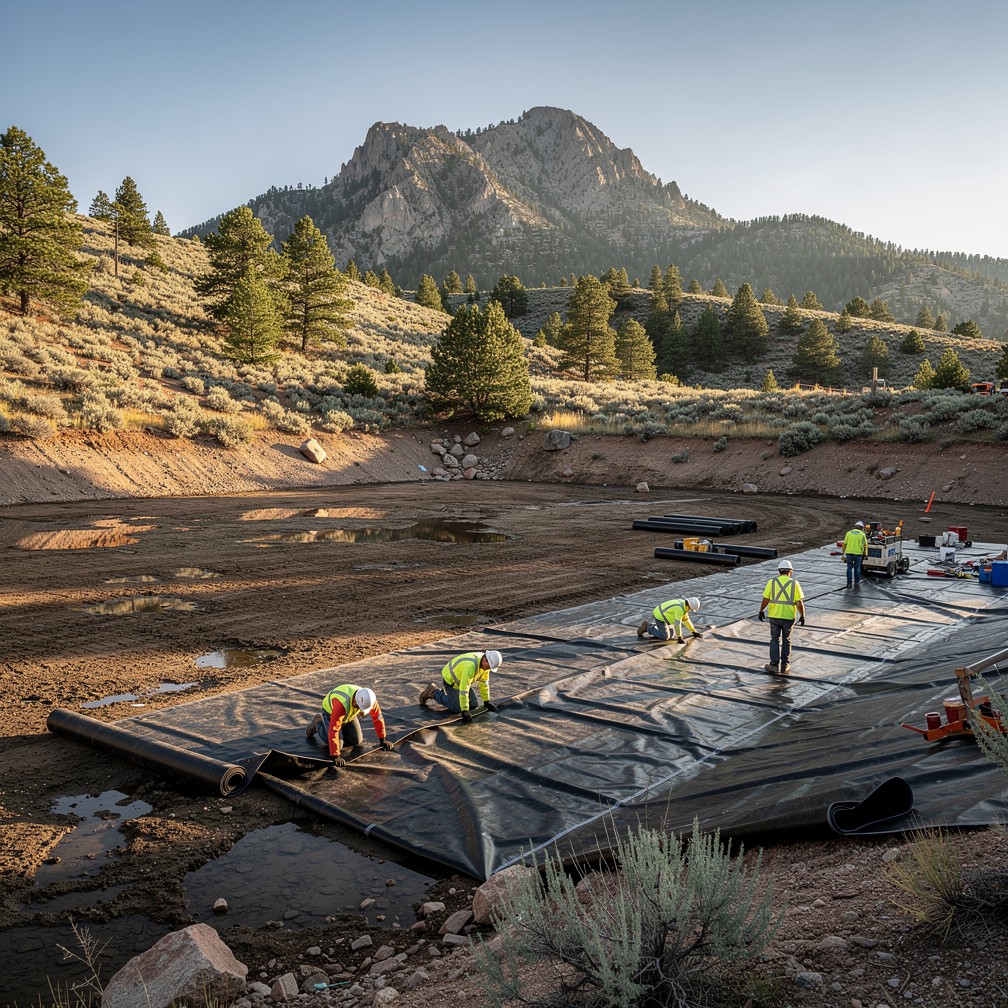
In Huerfano County, USDA Rural Development granted $1,576,000 to the Sheep Mountain Augmentation Facility to repair its damaged reservoir liner. A liner is the waterproof layer that keeps stored water from seeping out. An augmentation facility stores water so it can be released to replace water a user takes out of priority, a common tool under Colorado water law.
What the Record Shows, and Where It Stops
The sources show three patterns. Large road programs move in phases over years. Repair and resurfacing take a steady share of funding. Water projects in small towns often depend on grants. The sources do not show whether 29 Road will be built, or what other work Phase 8 of I-70B might include.
Lessons for Owners Planning Work
Think of a buried site like a sealed box: the plans are a guess at what is inside until someone opens it. The Grand Junction delay is a reminder. For municipalities and developers, three steps help:
- Invest in subsurface investigation, such as soil borings and utility locating, before final design.
- Set schedule and budget contingency for what investigation cannot find.
- Coordinate water, sewer and stormwater work with road phases so streets are dug up once, not twice.
We are Solid Earth, a woman-owned civil constructor based in Pueblo and working in Colorado since 1996. We build water, sanitary sewer, stormwater, earthwork and self-performed concrete, and 3D machine control and GPS grading have been standard across our fleet since 2015. We follow projects like these because they shape where Colorado’s infrastructure work is heading.
Have a project in mind? Start the conversation with Solid Earth.
Images are presented for illustration purposes only.We use real photographs when we need to show what was happening at a real event.
About the Author: Solid Earth

Related Posts


Recent Works