


Soil classification, not trench depth alone, determines what protective system a Colorado excavation needs. Along the Front Range, the geology rarely cooperates with the most favorable classification. Expansive claystone, weathered shale, fissured bedrock and decades of previously disturbed urban fill push most trenches toward Type B or Type C soil — which means flatter slopes, wider footprints, or engineered shoring and shielding. Crews that plan for Type A conditions and then discover otherwise at 6 feet lose a day. Crews that guess wrong and keep digging lose more than that.
The regulatory baseline every competent person works from
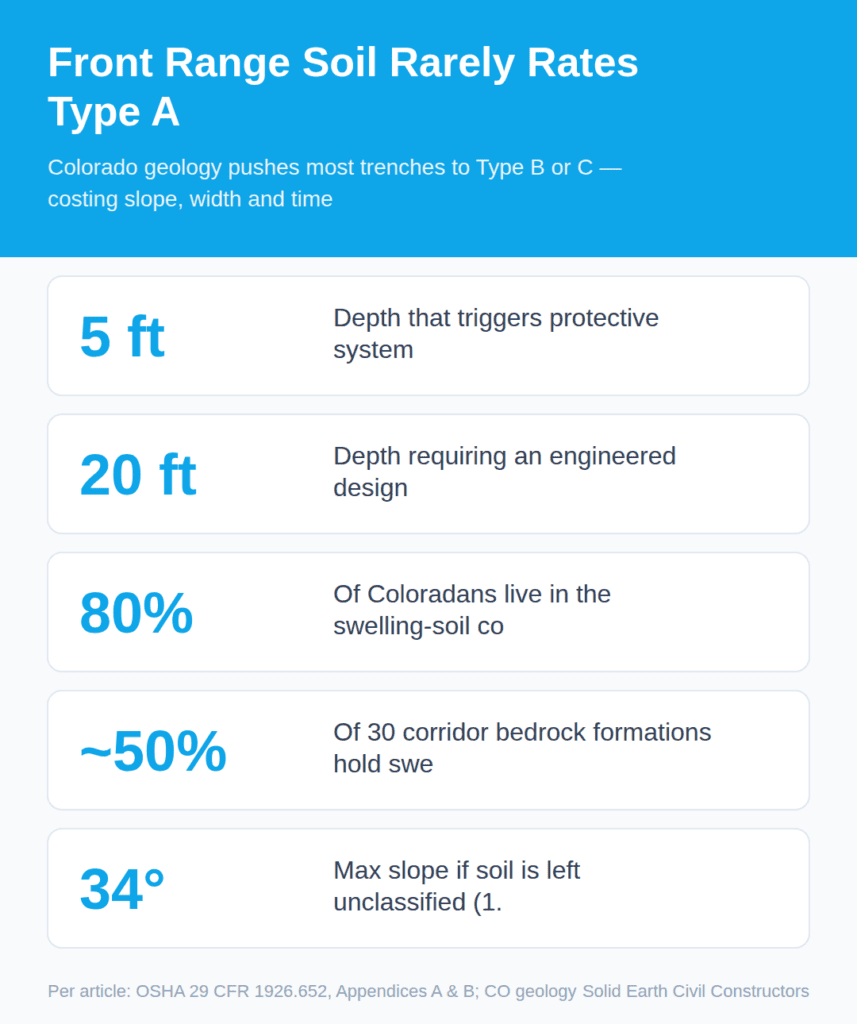
Depth sets the trigger. Trenches 5 feet deep or greater require a protective system unless the excavation is made entirely in stable rock; below 5 feet, a competent person may determine that no protective system is required. The standard itself is written the same way: 29 CFR 1926.652(a) requires each employee in an excavation to be protected from cave-ins except where the excavation is less than 5 feet deep and examination of the ground by a competent person shows no indication of a potential cave-in.
A competent person, in OSHA’s usage, is an individual capable of identifying existing and predictable hazards and authorized to take prompt corrective measures. That authority matters. The classification call is not a paperwork exercise; it is the input that everything downstream depends on.
At the deep end, discretion ends. Trenches 20 feet deep or greater require a protective system designed by a registered professional engineer, or one based on tabulated data prepared and approved by a registered professional engineer.

What soil classification actually measures
OSHA’s excavation standards require a competent person to classify soil and rock deposits into four categories — stable rock, Type A, Type B and Type C — using factors that include unconfined compressive strength, the load per unit area at which the soil fails in compression. Classification combines at least one visual test and one manual test, and it is a continuous obligation, not a single morning judgment.
Type A is the strongest cohesive category. Appendix A allows cohesive soils such as clay, silty clay, sandy clay and clay loam, plus cemented soils like caliche and hardpan, to qualify as Type A — but disqualifies any soil that is fissured, subject to vibration from heavy traffic, previously disturbed, or part of a sloped, layered system where the layers dip into the excavation at 4H:1V or steeper.
Those four disqualifiers are the reason Type A is uncommon on Front Range civil work.
Why Front Range geology pushes classification down
The corridor is defined by expansive clay. Swelling soils are a major geologic hazard in the Front Range Urban Corridor, which runs from Fort Collins and Greeley south to Pueblo and Cañon City and holds more than 80 percent of Colorado’s population. About half of the 30 sedimentary bedrock formations exposed in the corridor contain swelling clay.
Bedrock attitude compounds the problem. Heaving bedrock is common along the Front Range piedmont where steeply dipping sedimentary bedrock containing zones of expansive claystone sits near the ground surface, notably in the Pierre Shale and other Upper Cretaceous formations. Steeply dipping layers are exactly the condition Appendix A flags when strata dip into an excavation, and steeply dipping claystone next to harder sandstone produces abrupt lateral changes in strength along a single trench run.

Moisture makes the material unstable over time as well as at depth. Bentonite-rich Pierre Shale and weathered claystone beneath the Denver metro, Colorado Springs and Pueblo areas swell when wet and shrink when dry, producing seasonal ground movement that ruptures utility lines and damages pavements and foundations. A trench wall that stood clean through a dry morning can fissure after an afternoon storm, after a water line leak, or after the third day of an open cut.
Add the urban variable: utility corridors in established Front Range cities are largely previously disturbed ground, and trenches beside arterial roads sit under heavy traffic vibration. Both conditions independently rule out Type A.
What the classification costs in slope and footprint
Slope ratios translate classification into geometry. Under Option 1 of 1926.652(b), an employer who does not classify the soil must slope the excavation no steeper than one and one-half horizontal to one vertical — 34 degrees from horizontal. That is the conservative default and it consumes the most surface area.
Classifying the soil buys back some of that footprint. Appendix B specifies that simple slope excavations 20 feet or less deep in Type B soil have a maximum allowable slope of 1:1, and that excavations 20 feet or less deep with vertically sided lower portions that are supported or shielded may be cut at 3/4:1, with the support or shield system extending at least 18 inches above the top of the vertical side. Where the lower portion is vertical but unsupported, the limits tighten: excavations more than 8 feet but not more than 12 feet deep with unsupported vertically sided lower portions are limited to a 1:1 slope and a maximum vertical side of 3.5 feet.

On a downtown utility replacement with 8 feet of pavement-to-invert depth and 12 feet between the curb and an existing gas main, sloping is often not available at any ratio. That is where trench boxes, hydraulic shoring and slide-rail systems stop being an alternative and become the only compliant option.
The stakes and the enforcement climate
The physics do not negotiate. A cubic yard of soil can weigh as much as 3,000 pounds — roughly the weight of a compact car. A partial wall failure does not need to bury a worker to kill one.
Federal attention followed a sharp spike. Twenty-two workers died in trenching and excavation work in the first six months of 2022, surpassing the 15 deaths recorded in all of 2021, prompting OSHA to launch enhanced enforcement initiatives. The final count was worse: 39 trenching and excavation deaths in 2022, more than double the prior year and the highest since 2005.
Practical implications for Colorado civil contractors
Three habits follow from the geology. First, treat Type A as the exception requiring proof, not the assumption requiring disproof — fissured claystone, dipping bedrock, traffic vibration and prior disturbance are all present across the corridor. Second, reclassify after weather and after time, because swelling clay changes strength with moisture rather than holding a single value. Third, size the protective system at the estimating stage: if the corridor width does not permit a 1:1 or 1.5:1 slope, the shielding cost belongs in the bid, not in a mid-job change order.
Images are presented for illustration purposes only.We use real photographs when we need to show what was happening at a real event.
About the Author: Solid Earth

Related Posts


Recent Works