


Most infrastructure is invisible until it fails. A water main is a pressurized pipe buried under a street; a wastewater treatment plant is a series of concrete tanks that take sewage apart biologically before the water goes back to a river. Neither gets attention until a street floods or a permit limit is missed. In 2026, several Colorado municipalities stopped waiting.
Why 2026 is a heavy construction year
Two forces are pushing at once: aging pipe and new money.
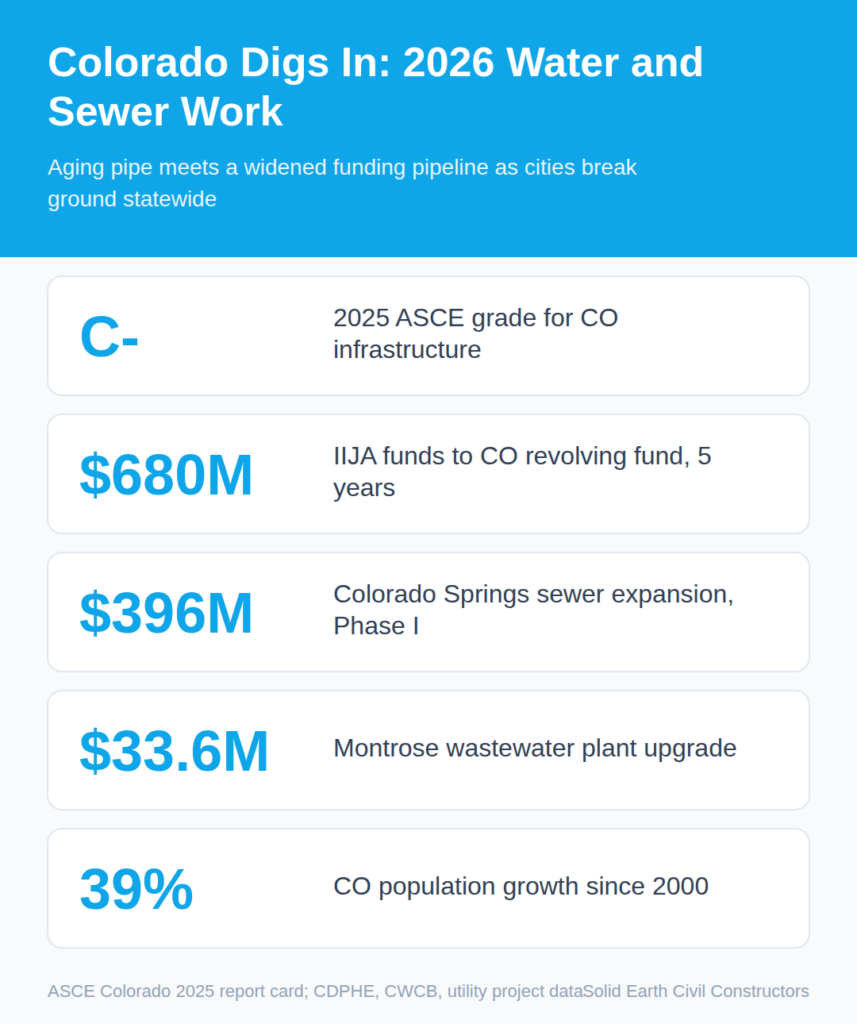
On the condition side, the 2025 Colorado Section of the American Society of Civil Engineers graded the state’s infrastructure a C- — unchanged from 2020, and one notch below the national C. Drinking water and stormwater each earned a C-; wastewater earned a C. The report card covered 14 categories and pointed to two pressures in particular: more extreme weather and 39% population growth since 2000. More people, more pavement, older pipe.
On the funding side, the pipeline of public dollars has widened. Colorado runs two State Revolving Funds — one for drinking water, one for water pollution control — that work like infrastructure banks, issuing low-interest loans to government agencies. They are administered jointly by CDPHE, the Department of Local Affairs, and the Colorado Water Resources & Power Development Authority, with CDPHE handling environmental review, design approval, and project management. Infrastructure Investment and Jobs Act money is sending roughly $680 million in additional dollars to Colorado’s State Revolving Fund over five years — about a fivefold increase in the annual allocation.
Grants add more. The Colorado Water Conservation Board anticipates approximately $37.7 million available across its 2026 Water Plan grant cycles, with allocations among agriculture, conservation and land use planning, engagement and innovation, storage and supply, and watershed health set at its May 2026 board meeting. Demand routinely exceeds it: in the March 2024 cycle, the CWCB received a record 70 applications requesting $25.6 million and funded 52 of them at $17.4 million. Federal basin money is also in play — in January 2025 the Bureau of Reclamation announced nearly $177 million for water projects in Colorado’s Upper Rio Grande and Upper Colorado River basins.

What is actually in the ground
Montrose — wastewater treatment plant upgrade. The city broke ground on March 16, 2026 on a major upgrade to a plant still running much of its original 1980s equipment. The work replaces that equipment and adds phosphorus removal — a treatment step that strips a nutrient which, left in a river, feeds algae blooms. By June 2026, major concrete work on the new anaerobic basin was nearing completion on the $33.6 million expansion, with excavation having started immediately after groundbreaking.
Colorado Springs — Eastern Wastewater System Expansion. Phase I is estimated at $396 million, slated to begin in 2026 and run through 2030, installing roughly 11 miles of new gravity wastewater mains plus seven miles of additional pipeline. A gravity main is exactly what it sounds like — sewage flows downhill, so the grade of the trench is the whole design. Utilities expects to finish preliminary design and pre-construction in 2026, start construction in 2027, and complete in 2030, eventually serving an additional 225,000 people.
Denver — pipe replacement. In January 2026 Denver Water began replacing nearly 8,000 linear feet of aging main along Sheridan Boulevard between West 13th and West 29th avenues, a multi-phase job expected to take about a year. It is one piece of a much larger program: the utility’s system holds more than 3,000 miles of main, crews install or replace about 80,000 feet per year, and the Lead Reduction Program outlook now runs 2026 through 2031. In 2025 the utility finished five miles of 130-year-old pipe under East Colfax Avenue and more than 3,300 feet in downtown Littleton, replacing lead service lines found along the way.
Arvada — new water treatment plant. The replacement facility is in design, with construction expected to start in late 2026 and operation anticipated by 2030, funded partly through customer rate revenue.
Grand Junction — Persigo plant. The Persigo Wastewater Treatment Plant expansion is under construction with completion set for August 2026.

Longmont — ongoing line replacement. The city maintains more than 450 miles of water line delivering over 5 billion gallons a year, which sustains a continuous replacement program rather than a single headline project.
What this asks of contractors
Read the list again and a pattern emerges. Treatment plant work is structural concrete in wet, tight excavations. Collection and distribution work is miles of trench held to tight grade. Both sit inside public funding programs with their own review and reporting steps.
That is the work we have built Solid Earth around since 1996: water systems, sanitary sewer, stormwater, earthwork, and structural concrete we self-perform with a crew established in 2009. 3D machine control and GPS grading — where the blade position is corrected against a digital design model in real time — has been standard across our fleet since 2015, which matters most on gravity lines where inches decide whether a pipe flows. We are a woman-owned company and hold M/WBE, SBE, and EBE certifications, and we were named Contractor of the Year in 2021.
Colorado’s grade did not move between 2020 and 2025. The projects now in the ground are the first real test of whether the current funding cycle changes that.
Have a project in mind? Start the conversation with Solid Earth.
Images are presented for illustration purposes only.We use real photographs when we need to show what was happening at a real event.