


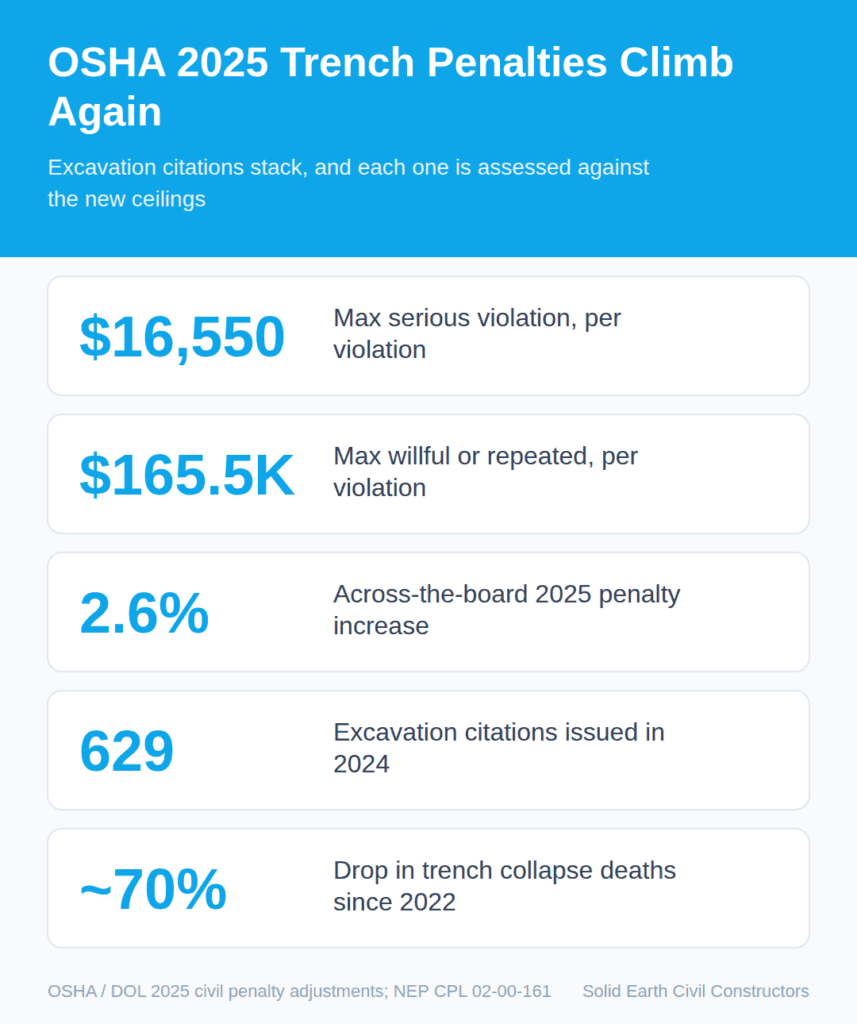
OSHA’s penalty ceilings went up again on January 15, 2025, and excavation work is where those numbers hit civil contractors hardest. The maximum penalty for a serious or other-than-serious violation rose from $16,131 to $16,550 per violation, and the maximum for a willful or repeated violation rose from $161,323 to $165,514 per violation, according to the Department of Labor’s announcement of adjusted 2025 civil penalty amounts. On a trench inspection, those are not one-time figures. They are per-violation figures, and a single open excavation can generate several.
Why the ceilings moved
The increase is arithmetic, not policy. Federal agencies are required to adjust civil monetary penalties for inflation each year under the Federal Civil Penalties Inflation Adjustment Act Improvements Act, passed by Congress in 2015. For 2025, OSHA applied a cost-of-living multiplier of 1.02598, derived from the October 2024 Consumer Price Index for All Urban Consumers, not seasonally adjusted, as set out in the agency’s 2025 annual adjustment memorandum. The floor moved too: the minimum penalty for a willful violation rose to $11,823 from $11,524, part of an approximately 2.6 percent across-the-board increase applied to OSHA and MSHA penalties.
Because the adjustment repeats annually, the practical planning assumption for any civil contractor is that exposure per violation rises every January. A citation deferred, contested, and settled two years from now is measured against the ceiling in force on the date of the violation, but the underlying trend is one direction.

Excavation citations stack
The reason the higher ceilings matter more in trench work than in most other construction activities is that excavation deficiencies rarely appear alone. The standards that govern the work are 29 CFR 1926.650, 1926.651 and 1926.652, and they cover distinct obligations: definitions and general requirements, specific excavation requirements, and requirements for protective systems. OSHA’s own guidance is direct on the basics. No worker enters a trench unless it has been properly inspected, spoil and materials stay back from the edge, and a safe means of entry and exit is provided.
An inspector who finds an unprotected trench frequently also finds spoil piled at the lip, no ladder within the required travel distance, and no record of a competent person inspection that shift. That is four separate alleged violations of four separate provisions, each assessed against the $16,550 serious ceiling. Repeat findings on a second project, or evidence that a supervisor knew the trench was unprotected, move items into the willful or repeated category and the $165,514 ceiling.
Trenching remains an enforcement priority
Excavation is not a low-attention corner of the construction standards. OSHA issued its current National Emphasis Program on Trenching and Excavation on October 1, 2018 under Directive CPL 02-00-161. A national emphasis program, or NEP, directs area offices to concentrate inspection resources on a specific hazard. This one targets construction excavation activity to reduce cave-in fatalities, and was issued after 130 fatalities occurred in trenching and excavation work between 2011 and 2016, with 104 of those in 2015 and 2016 alone. Under an NEP, a compliance officer who drives past an open excavation has standing direction to stop.
The enforcement volume follows. In 2024, OSHA recorded 12 fatalities linked to excavating activities and issued 629 citations for excavation safety violations. At current ceilings, a fraction of those citations carries six-figure aggregate exposure.

The fatality trend, and why it does not lower the stakes
Trench collapse deaths have fallen sharply from their recent peak. The Department of Labor reported that worker deaths in trench collapses declined nearly 70 percent from calendar year 2022, from 39 in 2022 to 15 in 2023 and 12 recorded to date in 2024. Subsequent counts put 2024 at 13 trench-collapse deaths, with the same reporting noting that successful trench rescues are rare because soil collapses too quickly for intervention. Other reporting tied to the annual Trench Safety Stand Down, organized with OSHA and the National Utility Contractors Association and held beginning June 16 in 2025, put the 2024 figure at 15, matching 2023.
The counts differ by source. The direction does not. Fewer deaths does not translate into fewer inspections, because the NEP remains in force and the penalty schedule keeps climbing.
What this means in Colorado specifically
Colorado does not run its own OSHA-approved state plan, so Colorado employers fall under federal OSHA jurisdiction for most private-sector workers. There is no state-level variation in the penalty schedule to plan around. Private-sector employers and workers here are served by federal area offices at 1391 Speer Boulevard, Suite 210 in Denver and 7935 East Prentice Avenue, Suite 209 in Englewood. Colorado also has a free, confidential On-Site Consultation Program that is separate from enforcement and does not result in citations or penalties, which gives contractors a route to have protective systems and competent-person practices reviewed without opening an enforcement file.

The practical read for civil contractors
Higher ceilings change the cost of an ordinary bad morning, not the definition of one. The controls that keep a trench compliant are the same ones that keep a crew alive: a competent person inspecting before entry and after any change in conditions, a protective system matched to soil classification, spoil set back from the edge, and a ladder or ramp within reach. Those are inexpensive relative to a single serious citation at $16,550, and immaterial relative to $165,514.
We have built water, sanitary, stormwater, and earthwork projects in Colorado since 1996, and excavation discipline is the part of civil construction where the regulatory math and the human math point the same direction.
Have a project in mind? Start the conversation with Solid Earth.
Images are presented for illustration purposes only.We use real photographs when we need to show what was happening at a real event.
About the Author: Solid Earth

Related Posts


Recent Works